
Preview in:
Scammers’ New Tactics
As AI and machine learning have advanced, scammers have developed new methods of deception. Today, it's easier than ever to edit photos or videos or even generate entirely fake faces with minimal skill.
Victims of online scams have reported the following tactics used by catfishers:
- Face Filters in Video Calls: The use of face filters has become widespread. These filters are often built into the apps we use daily and can be difficult to detect.
- AI-Generated Faces: AI-generated faces have become so common that it's increasingly difficult to tell if a face is real or not.
- AI-Generated Voices: AI voice technology has made it easy for scammers to send voice messages that conceal their accents or make them sound like they're from another country. To recognize AI-generated voices, you can listen to popular examples on platforms like ElevenLabs.
Past Challenges in Detecting Online Scams
In the past, identifying a scam was much harder. There were no dedicated tools for detecting fraud, and AI technology was rapidly evolving. However, today, things are improving as new solutions emerge to help expose scammers.
Using Facial Recognition to Combat Dating Scams
Breakthrough Research
Recent studies, such as this one, suggest that AI-generated images can sometimes be identified by analyzing light reflections in the eyes. Additionally, news outlets like The Guardian have published tutorials on how to spot deepfakes. These resources are valuable tools for protecting your privacy online.
Free Facial Recognition Tools
Not All AI is Dangerous
While AI is often associated with scams, it’s also a tool we can use to detect fraud. Many scam-detection websites leverage the same AI technology used by scammers.
This article offers an in-depth explanation of how AI works in image searches and detection, showing that it's not magic but sophisticated software.
Face Recognition Tools Online
Many scammers use AI-generated or stolen photos. To verify if you’re dealing with a fake, try lenso.ai’s face search*.
*Available in select regions

How to Use It:
- Go to lenso.ai.
- Upload the images you received. Don’t worry—lenso does not store them permanently.
- View the results in the People category and look for suspicious details.
What to Look For:
- No results for the same face, but different faces in the People category—this could mean the image was AI-generated.
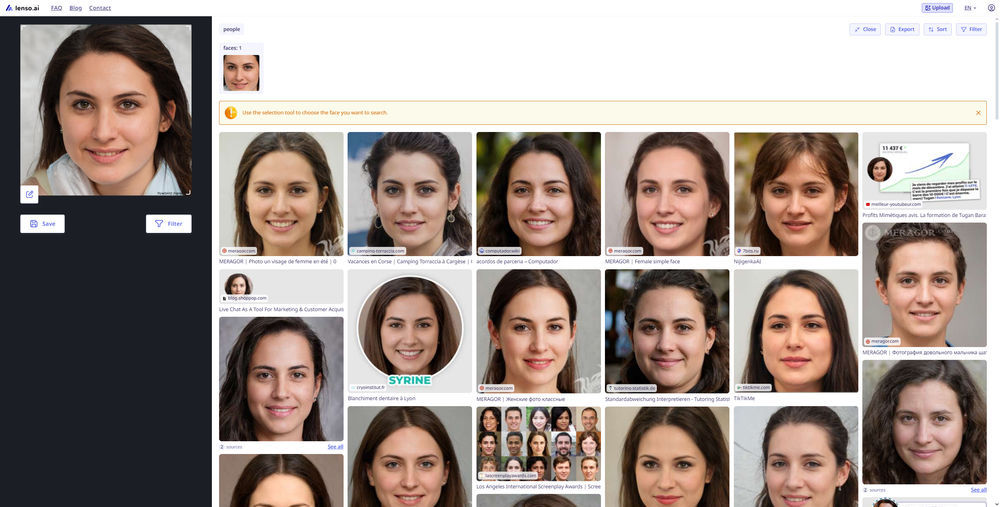
- No results at all—while most people have some online presence, not finding photos isn’t necessarily a red flag. Look for other warning signs.
- Results with the same face but different names or locations—this could indicate that the image was stolen, or the person has lied about their identity.
How to Confirm It’s the Same Person:
If you find several matching images, try to locate older ones to ensure authenticity. Sometimes scammers upload fake information across different platforms. With lenso, you can sort by “Oldest to Newest” to find the earliest matches.
Spotting scams can be challenging, but as AI advances, so do the tools to expose scammers. Visit lenso.ai to conduct a reverse image search today.

Author
Kinga Jasinska
Marketing Specialist
Continue reading
![TOP 10 Reverse Image Search Tools [2026]](https://img.lenso.ai/blog/top-reverse-image-search-tools?updatedAt=1738759682322&tr=w-768,h-auto)
News
TOP 10 Reverse Image Search Tools [2026]
Check out the ultimate list of the best reverse image search tools in 2026! Find the perfect image search engine that allows you to search for similar images or dive deeper with face search, duplicate and location finders.

News
Set up Notifications for Your Face Online | Lenso.ai Alerts
Wondering if your face is being shared online without your knowledge? Thanks to Alerts on lenso.ai, you can set up notifications for your face. This way, you will never miss a photo that’s been shared on the internet. Learn how lenso.ai helps you protect your image online with free Alerts and email notifications!
News
Best PimEyes Alternatives & Competitors for reverse face search in 2026
Looking for an accurate facial recognition tool that's not the popular one? Discover and try best PimEyes alternatives and competitors in 2026.